



ABOUT OUR EXPERT

Ms Leow is a Lecturer at the National Institute of Early Childhood Development – Ngee Ann Polytechnic (NIEC (NP) Campus). She teaches pre-service and in-service educators in modules and courses related to child development, early intervention, special needs and learning support, and coaching and mentoring. Having previously worked with children with added needs and their caregivers, she is keen to advance in her teaching practice.
With the increasing emphasis on practitioner inquiry, innovation and addressing the diverse needs of children and their families, early childhood (EC) educators face the challenge of staying relevant and effective in an evolving EC landscape.
One way, says NIEC lecturer Ms Fiona Leow, is to foster a culture of collaborative and flexible professional learning. Known as ‘Bricolage in a Community of Practice’ or BCoP, this approach reimagines professional development (PD) as dynamic, participatory experiences, empowering educators and making PD more meaningful.
COLLABORATIVE LEARNING THROUGH COMMUNITY
In January 2022, while still a new lecturer at NIEC, Ms Leow joined a study group initiated by Deputy Dean (Curriculum and Planning) Dr Yvonne Pek to learn how to review literature. This marked the beginning of a two-year initiative with several NIEC colleagues and partners from the National Institute of Education, Nanyang Technological University (NIE-NTU), and ECDA.
From this collective inquiry, the idea of combining bricolage with communities of practice emerged. “It’s a creative approach to professional learning and inquiry using available EC resources, models and theories to collaborate and find solutions together,” explains Ms Leow.
The term “bricolage” means using what is at hand to create something new and was introduced by French anthropologist Claude Lévi-Strauss in the 1960s. From the bricolage lens, the community of practice becomes a space where colleagues can learn together by pulling resources together for a new purpose and solve problems or gain new insights. Practised within a community of peers, Ms Leow believes bricolage fosters collegiality, shared responsibility, and a positive learning culture where EC educators feel supported, valued and respected.
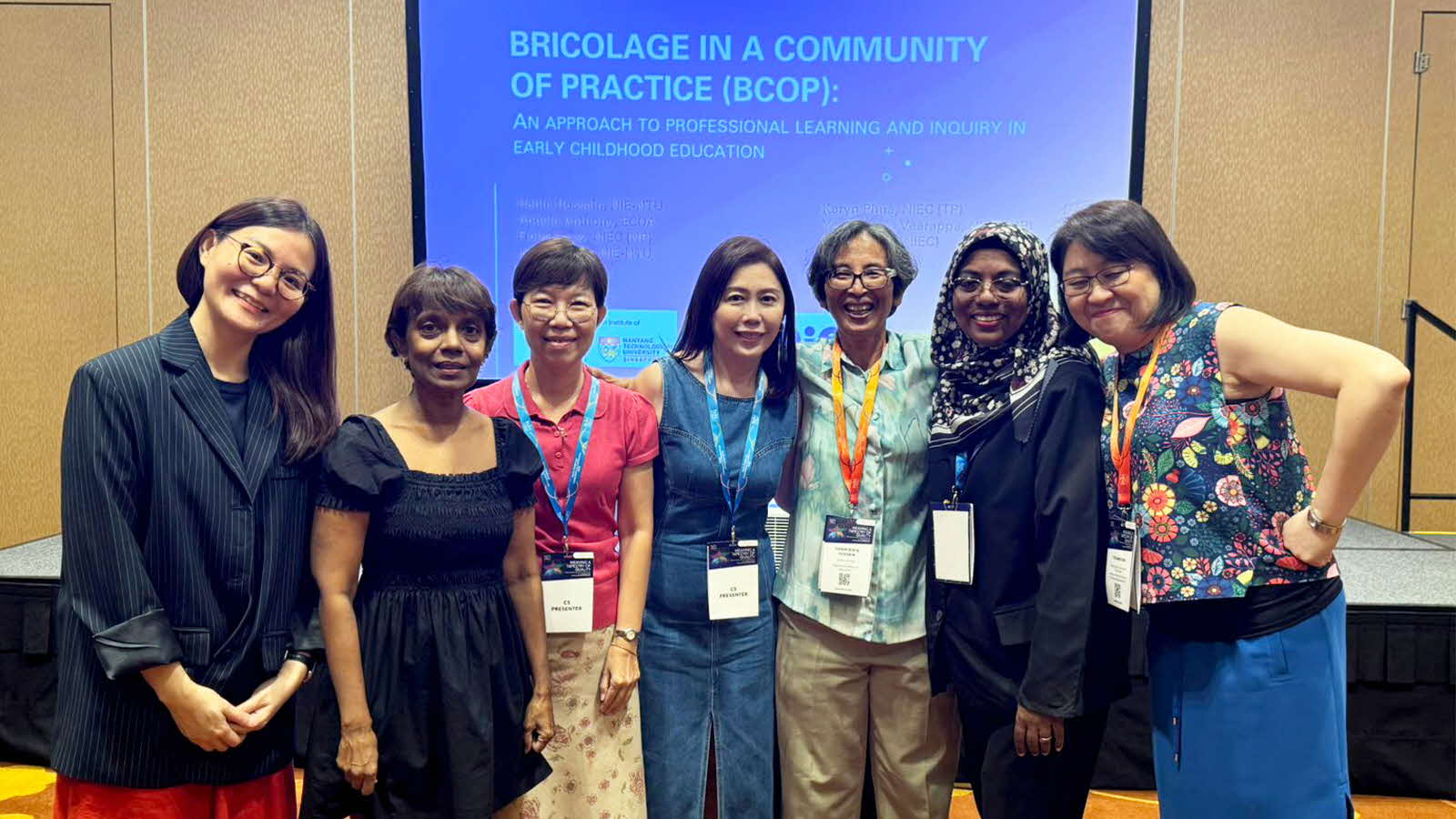 Ms Leow (far left) with fellow study group members (left to right): Ms Angela Anthony, Senior Assistant Director, ECDA; Ms Jemima Yeo, Teaching Fellow, NIE-NTU; Ms Karyn Phua, Lead Lecturer, NIEC – Temasek Polytechnic (NIEC (TP)); Dr Hanin Hussain, Senior Lecturer, NIE-NTU; Ms Yasotha Veerappa, then Lead Lecturer, NIEC (NP); and Dr Yvonne Pek, Deputy Dean, Curriculum and Planning, NIEC.
In September 2025, Ms Leow and her group introduced educators to the BCoP approach during a concurrent workshop at ECDA’s Early Childhood Celebrations & Conference (ECCC) 2025. They shared practical insights on how collaborative and flexible professional learning can transform practices and shape mindsets.
THREE STRATEGIES IN BCOP
Three practical, actionable strategies make the BCoP approach both effective and empowering for educators.
- Create a Safe, Supportive and Inclusive Community
Joining a study group can feel daunting, even for seasoned professionals. Establishing clear norms from the outset helps create psychological safety. “We agreed from the start that everyone’s contributions would be respected, regardless of experience, and no question was too silly,” says Ms Leow.
For example, some members in the study group initially found the literature review process overwhelming. They were encouraged to take small steps, such as using search keywords and compiling data in a literature review matrix.
- Harness Technology Tools to Share, Organise and Value Ideas
Use a range of technology tools to help group members document learning, organise shared resources and make contributions visible. As some educators may be less tech-savvy, consider a combination of digital and paper-based tools.
Ms Leow’s team used platforms such as Microsoft OneDrive to store meeting notes and Microsoft Excel to organise literature searches and analyses. They also adopted new applications like Zotero, a reference management software, to annotate, cite and share scholarly articles.
- Maintain a Structured Yet Informal and Flexible Learning Process
Even with shared group goals and scheduled meetings to keep the group on track, each person can learn at their own pace. This balance of structure and flexibility supports deeper engagement.
“For us, storing information with tech tools provided a sense of structure and helped us track milestones,” says Ms Leow. “We could also choose to read subtopics of interest and share what we learned.”
At the ECCC workshop, Ms Leow and her co-presenters introduced the three strategies, facilitating discussions on how educators can apply BCoP in various contexts, including:
- Implementing a mentoring framework to nurture professional growth
- Supporting early years educators in embedding the key principles of the Early Years Development Framework in their practice
- Rolling out the Leadership Development Framework to strengthen leadership skills
- Designing outdoor learning experiences tailored to the developmental needs of infants and toddlers
These frameworks are part of ECDA’s ongoing efforts to enhance EC quality and provide targeted support for leaders and educators. Since then, workshop participants have shown interest in adopting BCoP as part of professional development and practitioner inquiry projects in their own centres.
“We hope these strategies empower EC educators to draw on one another’s strengths and use available resources creatively to collaborate, grow professionally together, and learn meaningfully and joyfully,” says Ms Leow.


