Your child is entering primary school next year, and they are still unable to do addition and subtraction. Should you be worried?
The short answer is no. At six years old, not knowing 2 + 2 is not a problem at all, especially when understanding symbols at this age is challenging. In fact, rushing children into learning skills before they are developmentally ready can become an issue.
“Gaps in foundational understanding of numeracy concepts and skills can be masked when children are pushed too quickly into applying mathematical symbols like “+” and “-” or rote recitation of multiplication tables,” says Dr Yong Foong Ling, Senior Manager of Faculty and Leadership Development at the National Institute of Early Childhood Development.
Every child’s learning journey is unique. Beanstalk spoke to Dr Yong to find out what milestones to look out for, and how you can support your child along the way.
SO, WHAT ARE OUR PRESCHOOLERS READY TO LEARN?
 A child sorting cubes according to colour.
While every child develops at their own pace, the Nurturing Early Learners Framework highlights the numeracy concepts and skills that children aged four to six are generally ready to learn and use:
- Sorting & Comparing: Noticing similarities, differences and relationships between objects (e.g. sorting and comparing size and colour)
- Number Identification: Identifying and using numbers in daily life
- Reliable Counting: Counting accurately up to 10 objects
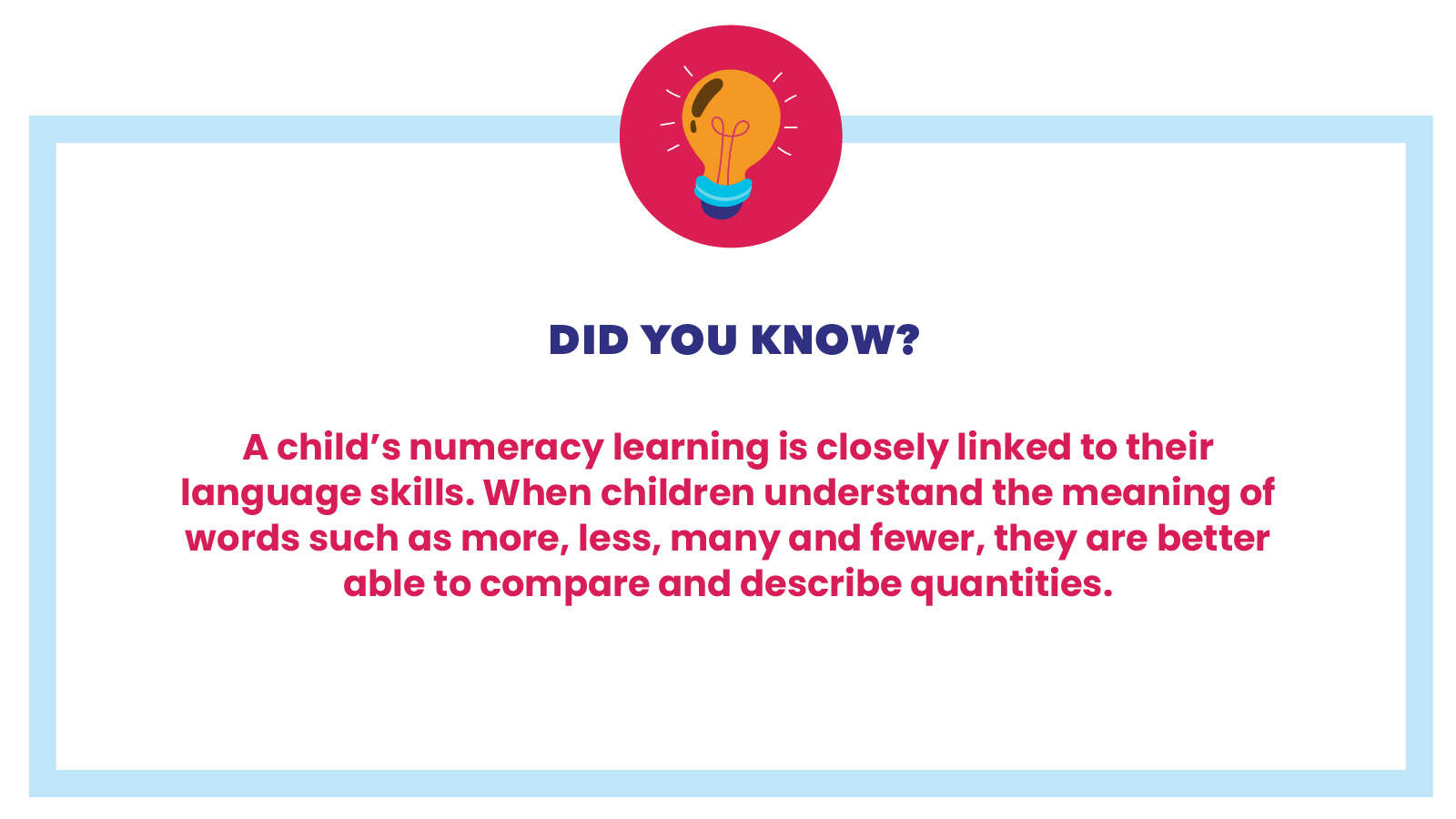
- Quantity Relationships: Understanding relationships between numbers and quantities (e.g. knowing “more”, “less” and “the same”)
- Patterning: Recognising, extending, and creating simple patterns
- Spatial Awareness: Recognising basic shapes and developing an awareness of spatial concepts (e.g. using words like “far” and “near”)
- Subitising: Identifying small quantities without counting them one by one (e.g. like dots on a dice)
What your child is learning in preschool is also aligned to the learning goals for children at the end of preschool education, illustrated in the Nurturing Early Learners Framework.
Progress in development may also depend on exposure. “Children who regularly encounter numbers through daily routines may develop a stronger number sense,” said Dr Yong.
PARTNER YOUR CHILD'S EDUCATORS
One early sign of numeracy difficulty is struggling to manage relationships and patterns (pre-number concepts). Preschoolers learn to notice similarities, differences, and relationships between objects through matching, sorting, comparing, ordering, and patterning. Children who experience ongoing difficulties may benefit from additional support.
Rather than focusing on specific behaviours, try having open conversations with your child’s educator. These questions might help you better understand and support your child’s numeracy development:
- What numeracy concepts are my child currently learning in class?
- How is my child progressing in numeracy skills for their age?
- Are there areas where my child may need more support or practice?
- What activities or strategies can we try at home to reinforce what was taught in class?
 Parents can support their child’s numeracy development through activities such as building with blocks.
TRY THESE: EVERYDAY ACTIVITIES FOR HOME
Understanding concepts and skills takes time and repeated exposure. Build upon your child’s prior knowledge and confidence by progressing from simple to more complex ideas through these daily routines.
1) Incorporate Numeracy in Daily Routines
- Do Laundry: Sort, match, and count laundry together. Ask problem-solving questions like: “Which pile has more? How do you know?”
- Set the Table: Ask your child to pass the correct number of plates, cups and utensils.
- Pose a Challenge: Ask problem-solving questions like: “If everyone eats two biscuits, how many do we need altogether?
- Toy Clean-Up: Turn tidy-up time into a treasure hunt or sorting challenge. Count how many toys go into each box and ask: “Which box has the most toys?”
2) Play Games & Activities to build Numerical Thinking
- Spatial Play: Building with blocks, solving puzzles and tangrams, and going on “shape hunts” develop children’s spatial awareness, and problem-solving skills.
- Patterning: Activities like threading coloured beads help children recognise relationships and predict what comes next.
- Storytime & Music: Books, rhymes, and songs that include numeracy concepts make learning fun.
- Tabletop Games: Number and counting games, such as board games and card games, build one-to-one correspondence, number recognition, counting in order, and the understanding that numbers represent quantities.
3) Get Creative with a Family Calendar: Use a large calendar that your child can draw on or add stickers to. It helps them develop an understanding of numbers, sequencing, and time. Try to:
- Count the days in a week or month together.
- Circle important dates and count-down to them (e.g. “How many days until your birthday?”)
- Talk about yesterday, today and tomorrow.
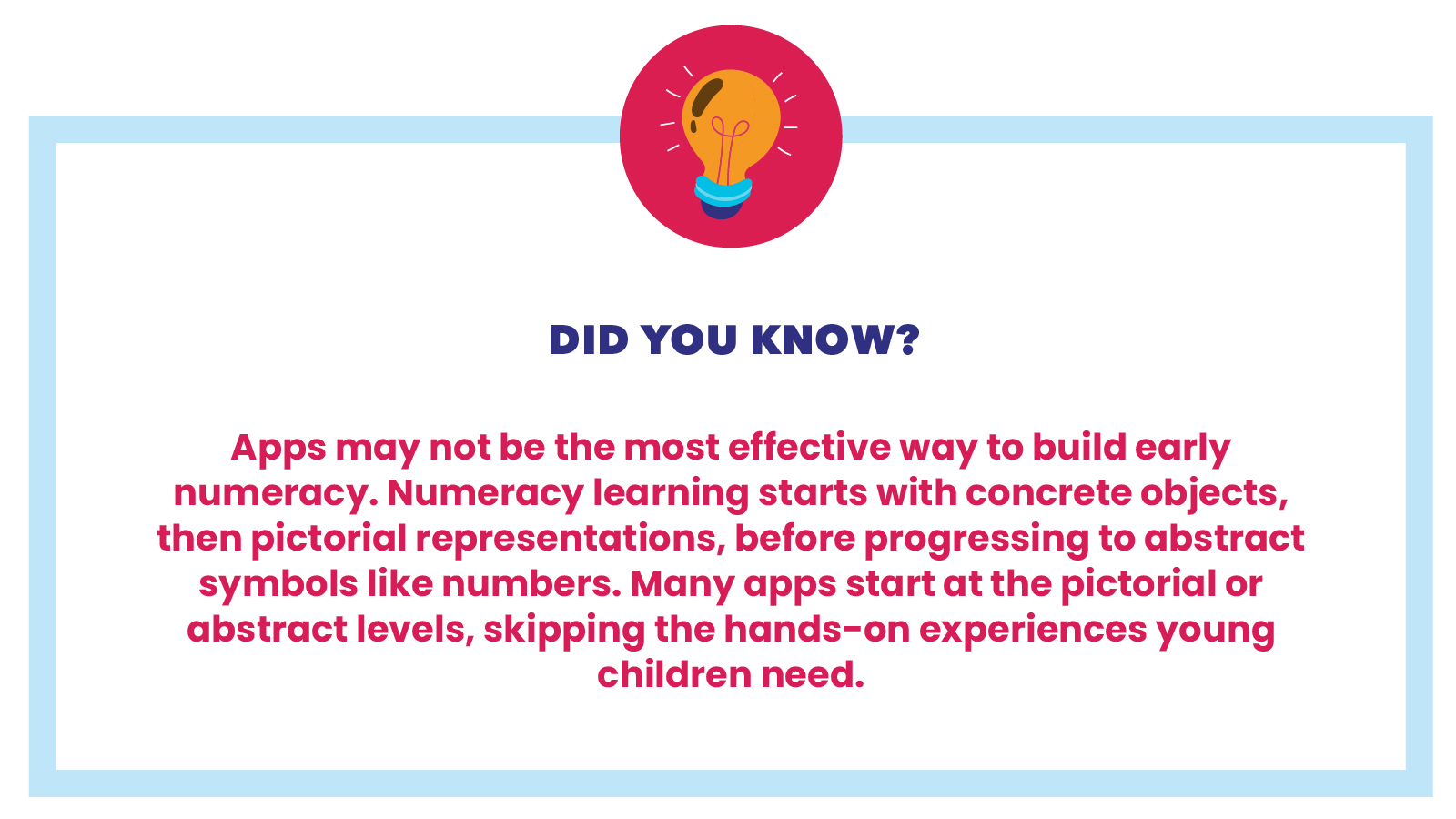
Ultimately, children learn numeracy concepts best when they talk about them, hear them used naturally, and link them to experiences.
“When children see how numeracy connects to real-life situations, they develop a deeper understanding and feel more confident,” said Dr Yong.
Learning is a journey that unfolds at each child’s own pace. You can support your child’s journey by understanding where they are at, and how they learn best.