

As with many young boys his age, Jayden (not his real name) dreamt of being a policeman. “I want to be a pulisman,” he wrote excitedly in school one day during an activity on childhood ambitions. His adorable misspelling of his ideal job, however, alarmed his mother.
During pick-up the following day, his mother asked to speak to Ms Siti Nur Amalina (Ms Lina), who was then his K1 teacher. “His mother told me, ‘I’m so worried, his spelling is always wrong. Should I send him for tuition or buy him assessment books?’” she recalled.
Ms Lina assured her that invented spelling — where children create or invent their spelling by using letters or groups of letters to represent the sounds they hear in words — is perfectly normal at his age.
But this remains a very common concern among parents, especially as their children get closer to attending primary school.
Ms Lina, who is now principal of Little Footprints Preschool @ Balestier reminded parents that it is important to know that learning to spell is a developmental process starting in preschool through their lower primary school years, where children explore different ways of expressing themselves through writing.
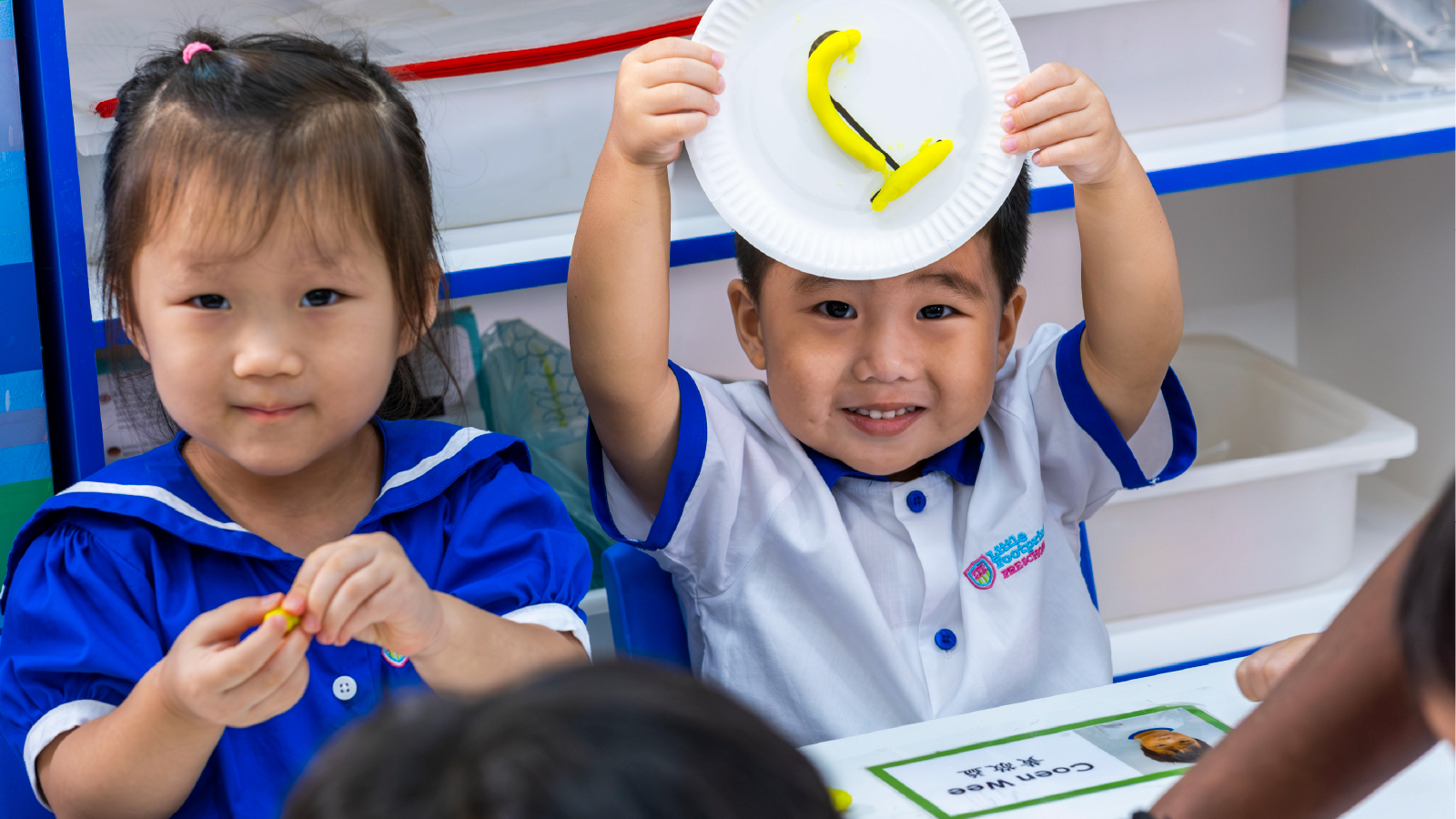 Early years children at Little Footprints Preschool @ Balestier are introduced to letters through fun activities where they form letters with playdough, for example.
UNDERSTANDING CHILDREN'S 6 CATEGORIES OF WRITING DEVELOPMENT
Every parent has witnessed their child’s writing journey, from those first scribbles to actual words on paper. Children typically progress through six categories of writing development, though they don't necessarily follow a fixed sequence and may move back and forth between categories as they learn.
- Drawing
Children know their drawing means something, even when it is not immediately clear to adults. When asked about what they have drawn, children can explain their work and the story behind it. “At this point, a picture of a cloud could have multiple meanings, such as a pillow or a marshmallow,” said Ms Lina.
- Scribbling
In this category, children begin distinguishing between drawing and writing. As fine motor skills develop, their scribbles start to resemble writing and are often in lines.
- Letter-like forms and symbols
Children begin to recognise letters of the alphabet and become aware of the different shapes that make up letters. Their writing starts to resemble letters and symbols which are randomly scattered among their drawings and scribbles.
- Random letters or letter strings
Children begin experimenting with actual letters in their writing, often starting with familiar ones from their own names or arranging letters in random sequences. Most naturally use uppercase letters, which are easier to form than lowercase letters, and commonly write letters backwards or upside down while mastering correct orientation.
- Writing with invented spelling
Children discover that spoken words are made up of sounds connected to letters. They invent spellings using letters to represent the sounds they hear, often using just the first letter to represent entire words.
- Writing with conventional spelling
Here, children progress from capturing just the most obvious sound in a word to writing nearly all the sounds they hear. “They no longer need to sound out words before spelling and can remember how they’re spelt,” explained Ms Lina. However, do not expect perfection just yet – English Language has irregular spellings like “blue” and “shoe” that may still challenge them.
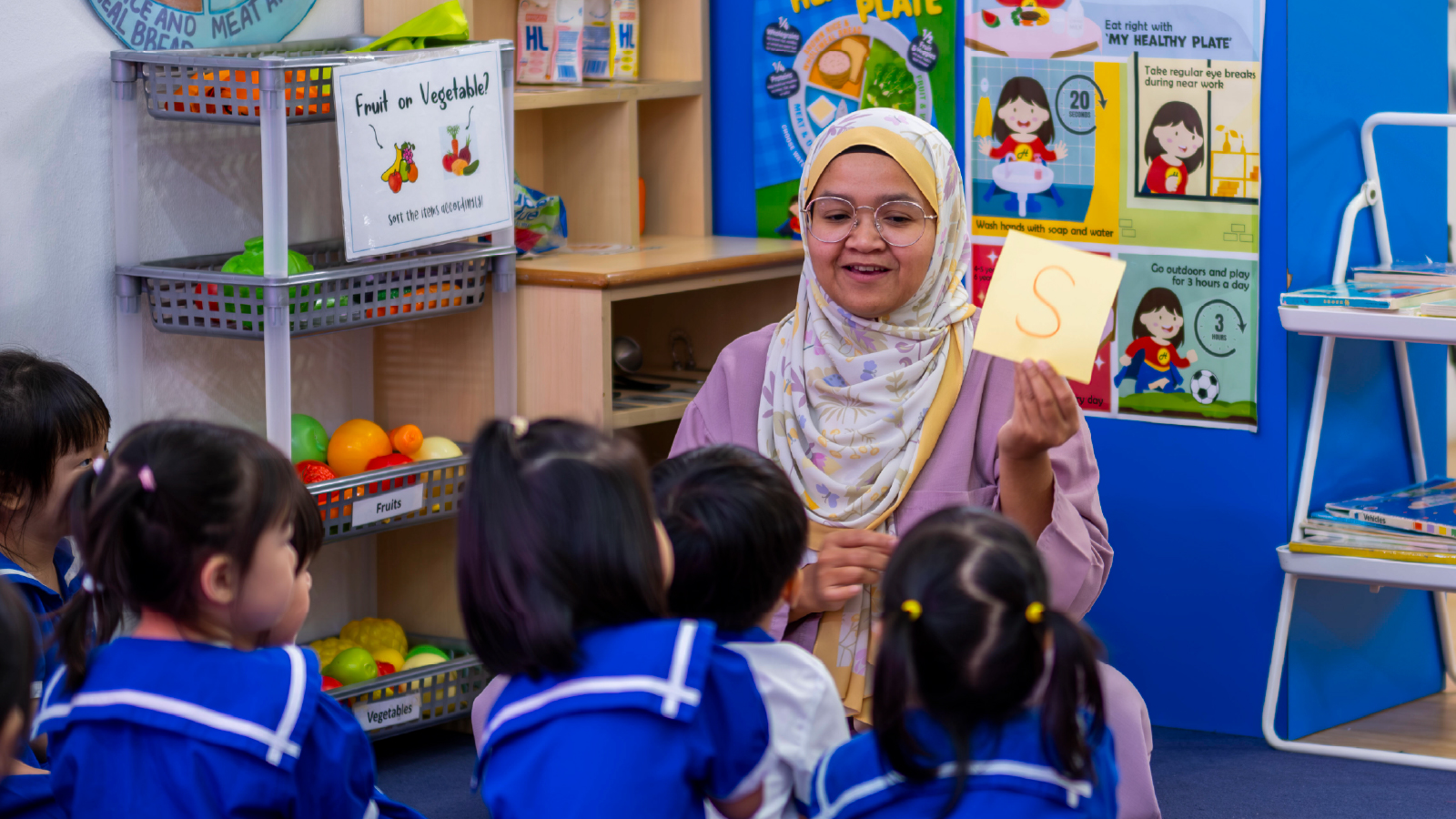 Ms Lina teaching students how to sound the letter ‘S’.
HELPING CHILDREN LEARN THROUGH SIMPLE EVERYDAY MOMENTS
The simplest yet most effective way parents can support their children’s spelling is to weave simple habits into daily life. Here are some activities to try:
- On the walk home or while waiting for the bus, encourage children to spot familiar things around them and sound out the letters in each word.
- During grocery runs, point out signs and labels on packaging and invite children to sound out the words and letters they see.
- During outings or free time, play the classic “I Spy” game with a twist. Say a word aloud and challenge children to find things nearby that sound similar. This builds phonemic awareness, which is the foundation of reading and spelling.