



When a child only attends preschool once a month or consistently arrives late, he misses out on more than just playtime. He is forgoing hours of structured learning that are essential to his holistic development - including social and emotional skills.
This is the reality for many children growing up in vulnerable households, where parents juggle irregular working hours, financial strain, and multiple caregiving responsibilities.
“Every family faces different challenges, which may not be immediately visible,” said Ms Artiqah Abdullah, an infant educator at PCF Sparkletots Preschool @ Kebun Baru Blk 109, who was also a beneficiary of KidSTART Singapore (KSL). “You don’t know what they are going through at home.”
WORKING WITH FAMILIES
Each child comes from a family with different needs. It is important for educators to be more mindful and consider these strategies when working with children from lower-income families:
- Be mindful when designing learning activities
Ms Artiqah shares that simple home-learning tasks should require minimal resources — a hand puppet made from household materials, or a five-minute conversation during bath time — because not every family has access to books or learning tools.
- Use concrete results to build trust
“Convincing parents to send their children to preschool every day becomes easier when they see improvements in their children’s learning and development,” said Ms Hayati Amid, centre leader at Ms Artiqah’s preschool.
Educators in her preschool help parents see these improvements firsthand by sharing short video clips of children learning in class and organising classroom playdates. These give hesitant parents the opportunity to observe how preschool strengthens their child’s social skills and attentiveness – changes that enrich the parent-child relationship at home.
- Approach families with empathy
Those working in early childhood development and social services understand that some of these families face challenges due to limited capacity, and should be met with empathy rather than judgement.
When a parent genuinely cannot send their child to preschool, educators can explore support from other family members — a grandmother or an uncle — or recommend support from the community to step in as an alternative caregiver. Ms Hayati added that centres should monitor irregular attendance from a distance, rather than approaching families in a manner that may feel confrontational.
EMPOWERING PARENTS TO SUPPORT A SMOOTH PRESCHOOL-TO-HOME TRANSITION
Beyond their involvement in the classroom, educators can also help parents connect with organisations like KSL to ensure that learning continues in a supportive home environment. KSL takes a child-centric, family-focused approach - addressing not just the child’s needs, but also the parents’ wellbeing, parenting skills, and access to community support, all of which contribute to the child’s holistic development beyond the classroom.
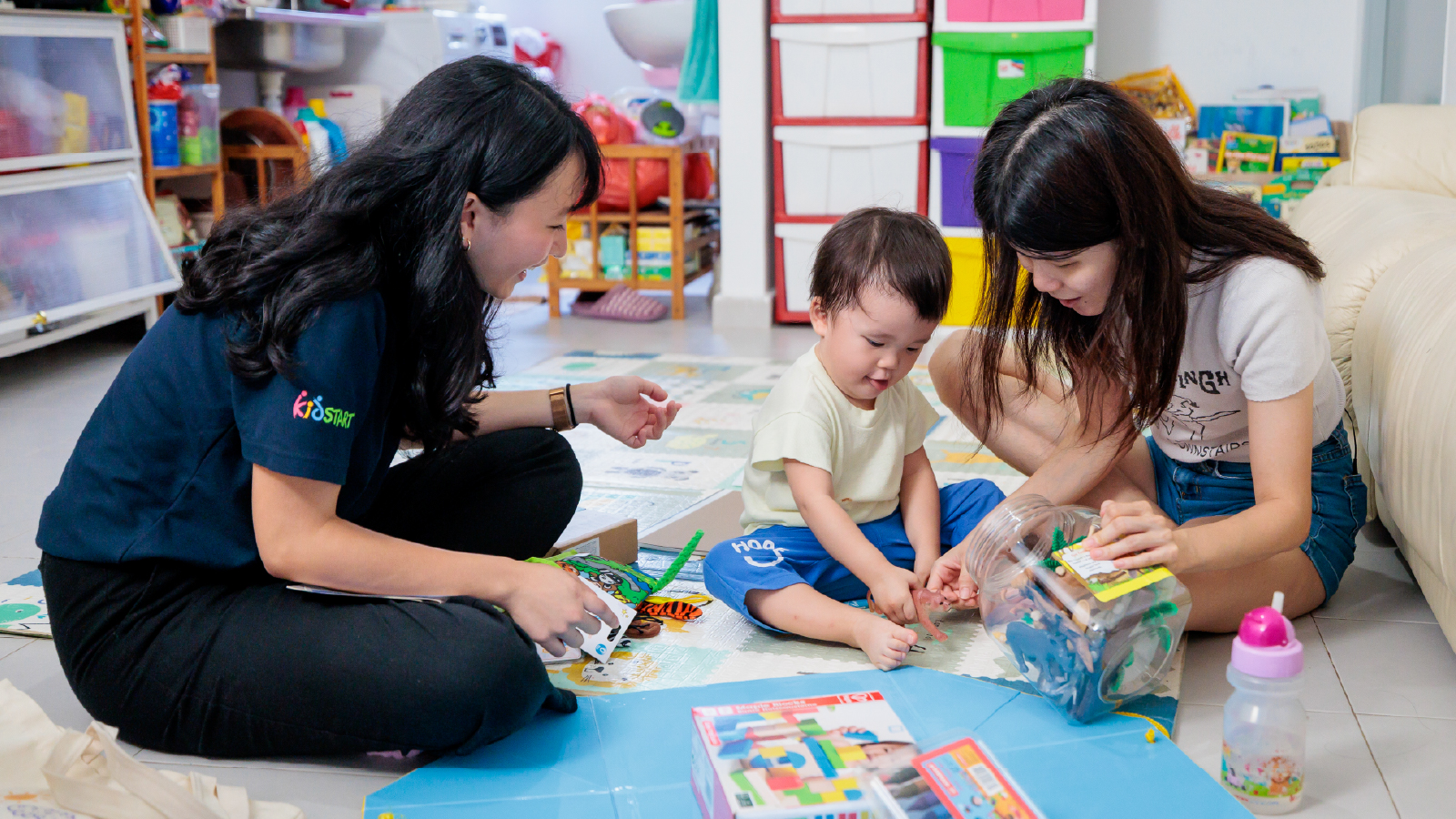 KidSTART practitioner conducting a home visit. (Photo credit: KidSTART Singapore)
Ms Puspavalli Namasivayam, an early childhood consultant from KSL, explains, “Our work is not with the child alone, but through the parents. By engaging parents to engage their children, we empower them to take an active and lasting role in supporting learning and development at home.”
A STRONG FOUNDATION SETS CHILDREN UP FOR SUCCESS
Every child, regardless of the circumstances they are born into, arrives with enormous potential. The earlier the intervention, the better.
Ms Artiqah’s own journey is a testament to what is possible. As a first-time mother, she struggled to understand her son’s developmental milestones and the importance of sending him to preschool regularly. “Slowly, they (KSL) came to our house, assessed my child, and shared how we could better support his learning and development,” she said.
With the support of the KSL team and her son’s educators, Ms Artiqah began to better understand how he learns, grew in confidence, and was ultimately inspired to join the early childhood profession herself.
Today, she guides other parents through the very experiences she once navigated and shares her perspectives with fellow educator colleagues to support children under their care.


