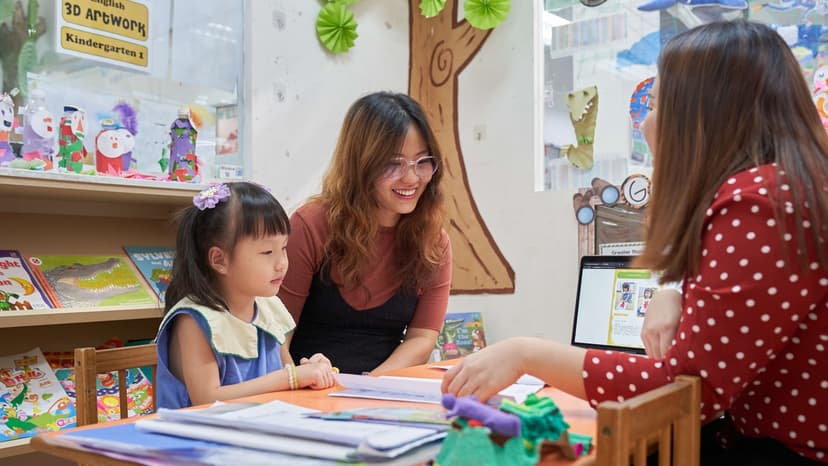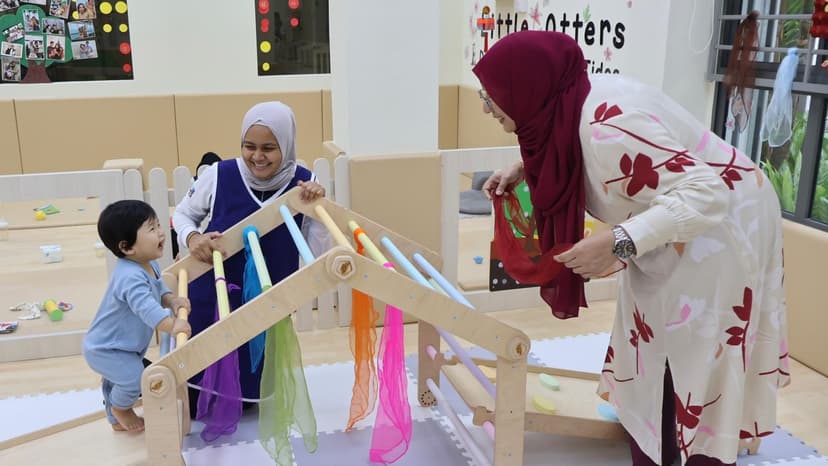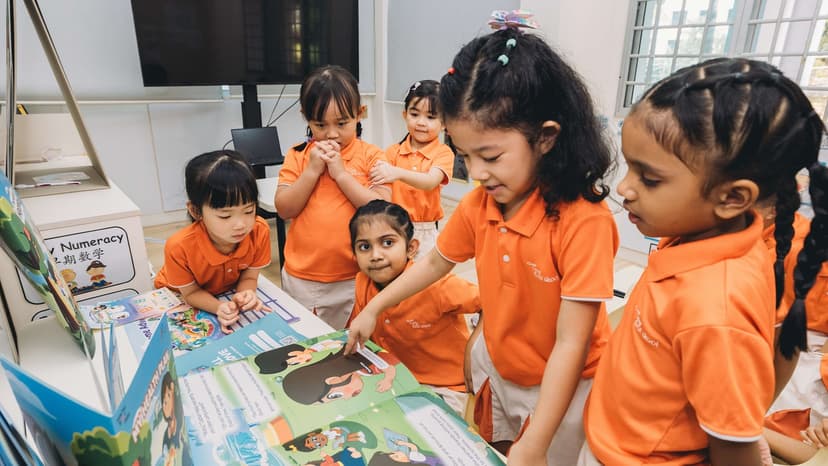
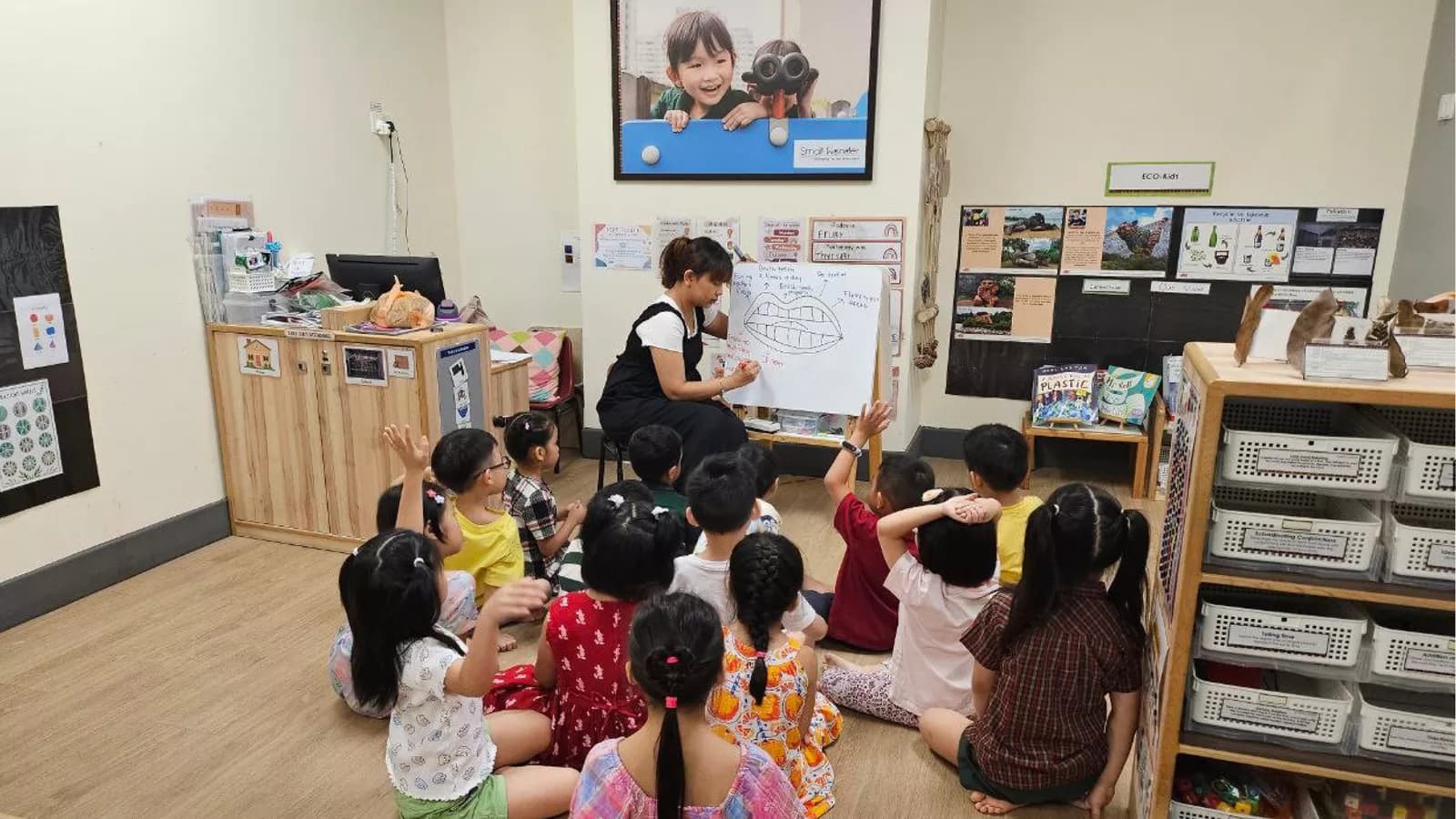

Six-year-old Hannah Chung looks forward to preschool every day. She loves learning and playing with her peers, including one of her classmates who has developmental needs. Her mother, Ms Jezebel Khoo, says, “She’s been in the same class as him since nursery level. She always smiles when she talks about him and what they did in preschool that day.”
Hannah attends Small Wonder (Nordcom II), one of six preschools in the Inclusive Support Programme (InSP) pilot. Launched by ECDA in October 2021, this pilot aims to better support children with developmental needs by integrating early childhood (EC) and early intervention (EI) services in local preschools. On 25 September 2025, ECDA announced plans to progressively expand the InSP from 2026 so that more children can benefit from it.
Under the InSP, all children — whether typically developing or with developmental needs — learn and play together in an inclusive preschool environment. Children aged 3 to 6 requiring medium levels of EI support receive targeted intervention within their preschools, without needing to shuttle between their preschool and an EI centre several times a week.
InSP preschools adopt evidence-based practices like Universal Design for Learning and differentiated instruction to cater to the children’s diverse needs and preferences. These strategies benefit not only children with developmental needs but all their peers in class — cognitively, socially and emotionally.
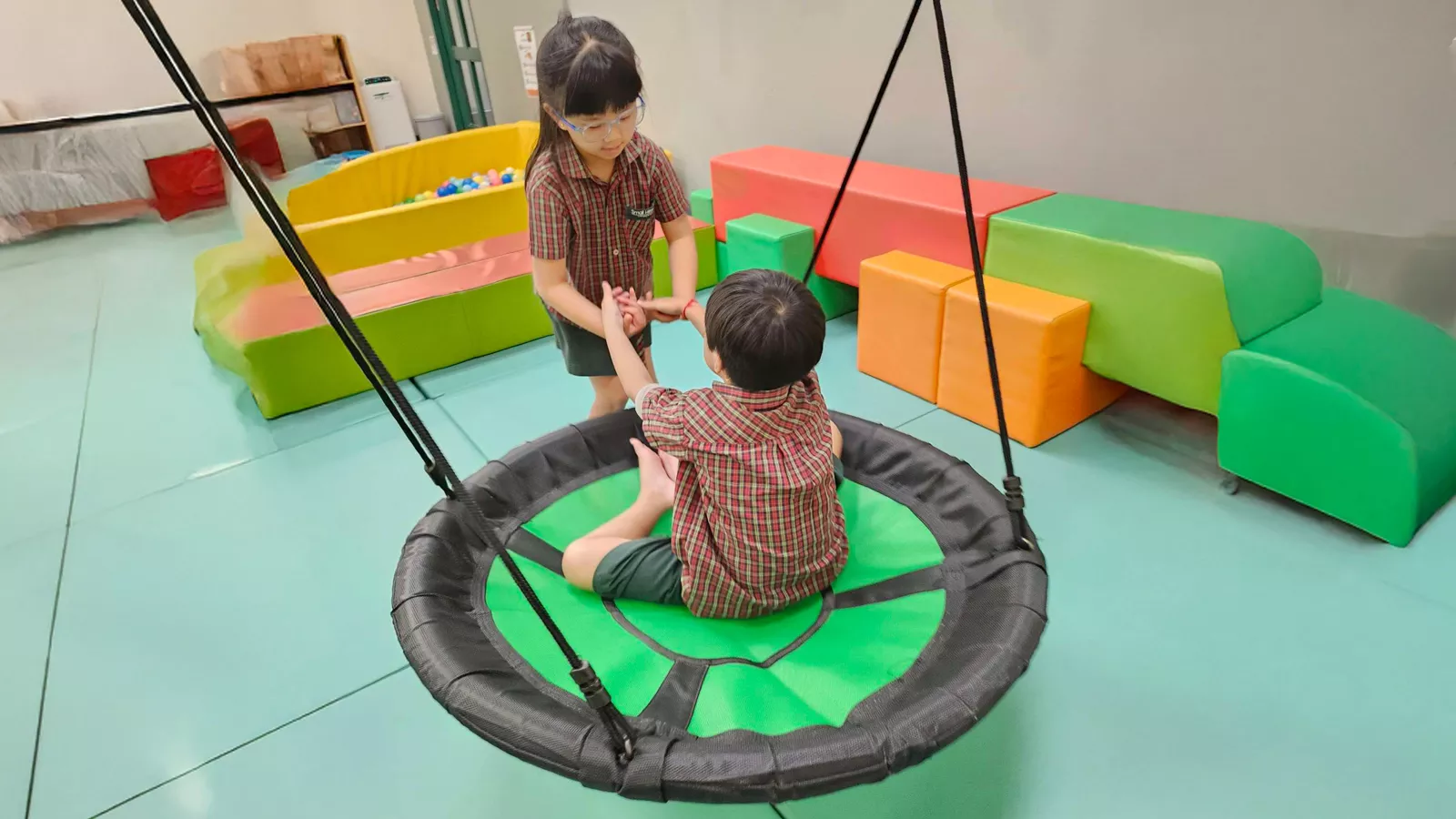 At her preschool’s play gym, Hannah demonstrates positive social behaviours such as sharing and helping while playing with her friend.
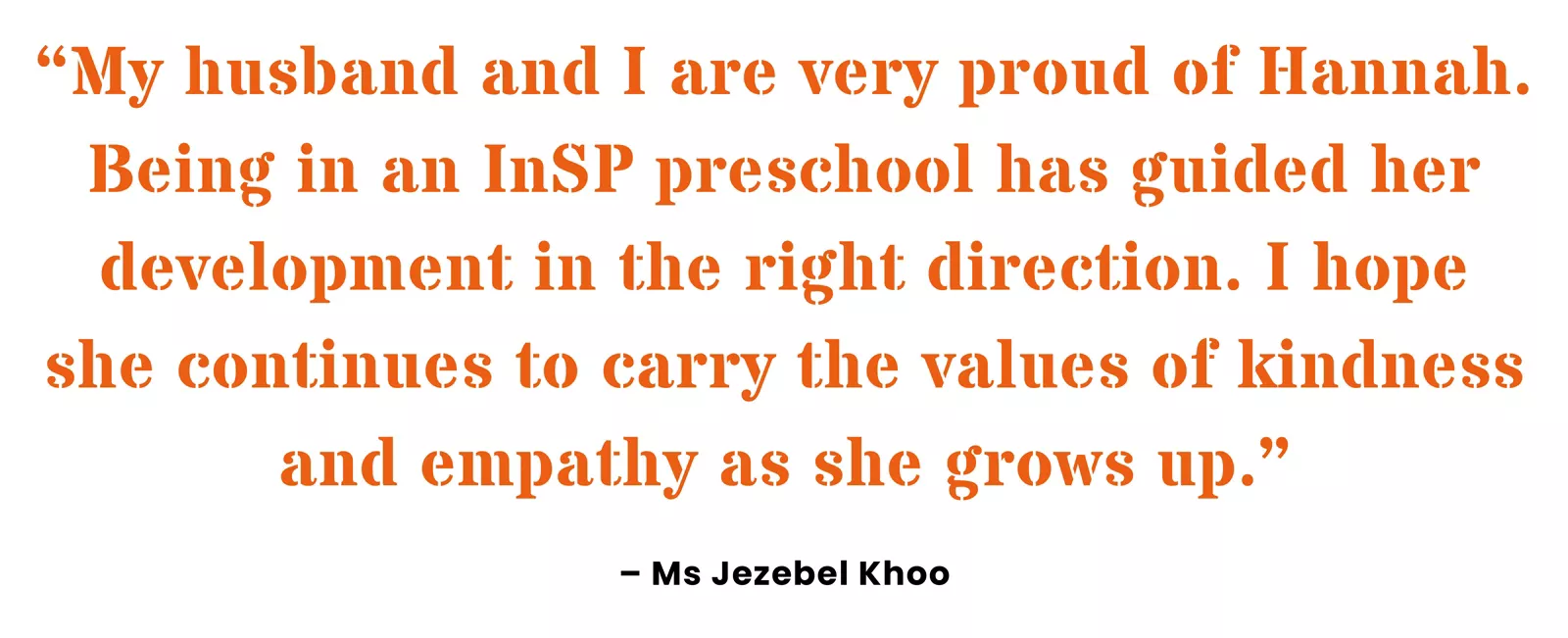
For Ms Khoo, the impact is clear. Over the last few years, she has seen Hannah become more empathetic and emotionally aware. “Hannah has gotten better at reading situations,” says Ms Khoo. “She knows when the right time is to speak up, when to listen, and when to be patient or tone down her emotions.”
Hannah’s teachers also shared that she is quick to help her peers in class. She carries this kindness beyond her preschool too, like when caring for her younger brother at home or offering to help neighbours with simple tasks.
In 2024, Hannah won the Little Heroes of Inclusion Award. Presented by Good Start SG, an advocacy group that seeks to advance evidence-based inclusive best practices in Singapore, the award recognises and celebrates children who show kindness and compassion to their peers with needs.
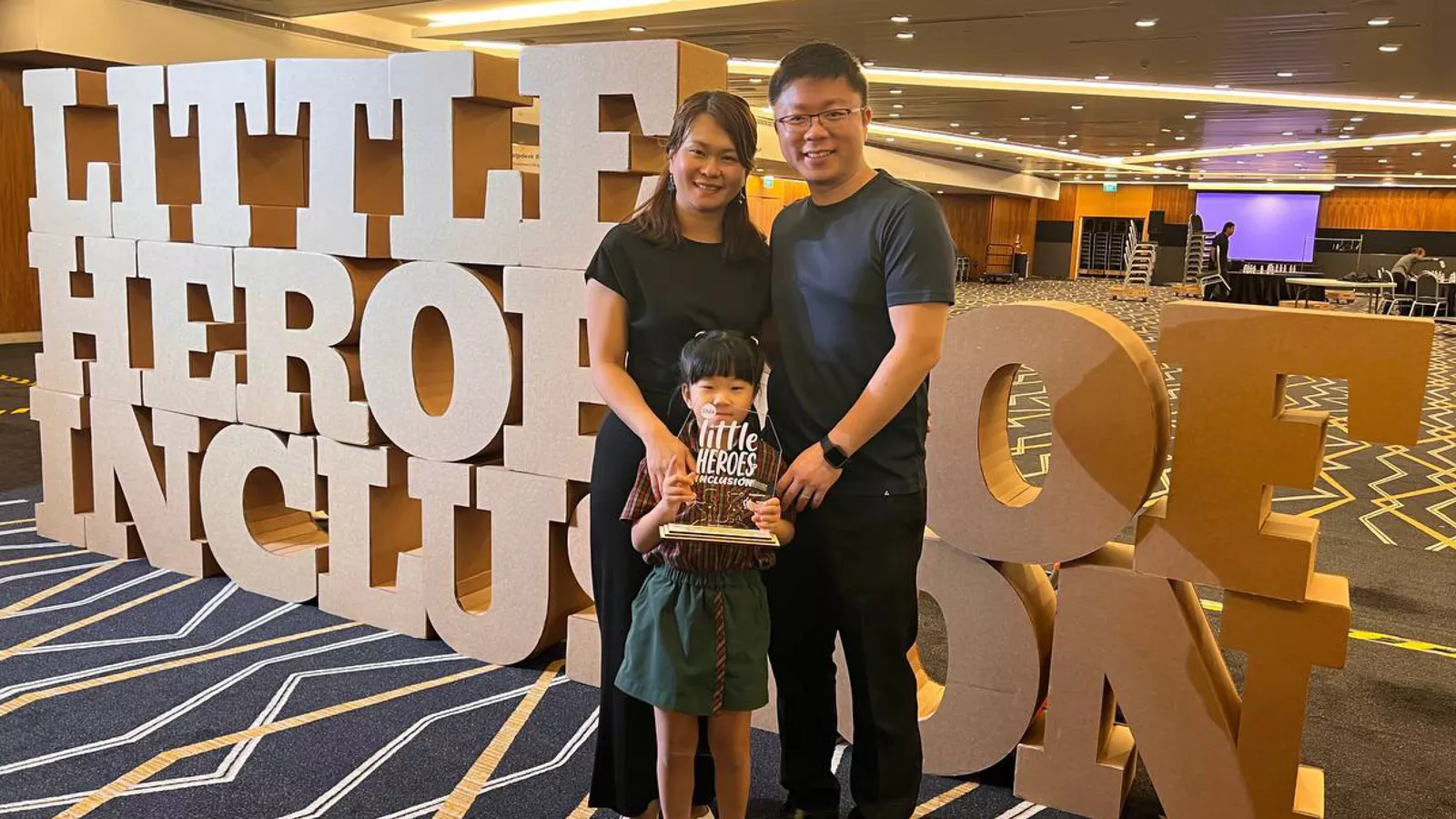 Hannah with her parents at Good Start SG’s Early Childhood Conference 2024, where she was presented with the Little Heroes of Inclusion Award.
LEARNING FROM EACH OTHER
Educators, too, have witnessed the InSP’s impact on children with diverse abilities. At one PCF Sparkletots centre, Ms Lee Wei Ling, an EI educator with PAP Community Foundation (PCF), recalls a moment during pretend play between two children acting as an ice cream seller and a customer. When the ice cream seller asked her classmate, who has developmental needs, how many scoops of ice cream he wanted, he struggled to reply. To offer him a different way to express himself, she held up her fingers and asked if he wanted one or two scoops. The boy replied with two fingers and beamed as he joined in the game.
“For the boy, it was a chance to practise language and social skills. For his friend, it was an opportunity to support a peer with visual cues and responsive communication,” says Ms Lee. “That’s the heart of inclusion — children learning with, and from, each other.”
In her preschool, Ms Lee — commendation winner of the 2025 ECDA Outstanding Early Intervention Professional Award — works closely with EC educators to co-plan and co-teach lessons to cater to different abilities and learning styles. This could mean ensuring multiple means of representation, such as providing concrete objects or visual aids for children who might need them; or engaging typically developing children more deeply by drawing on their interests and giving them choices.
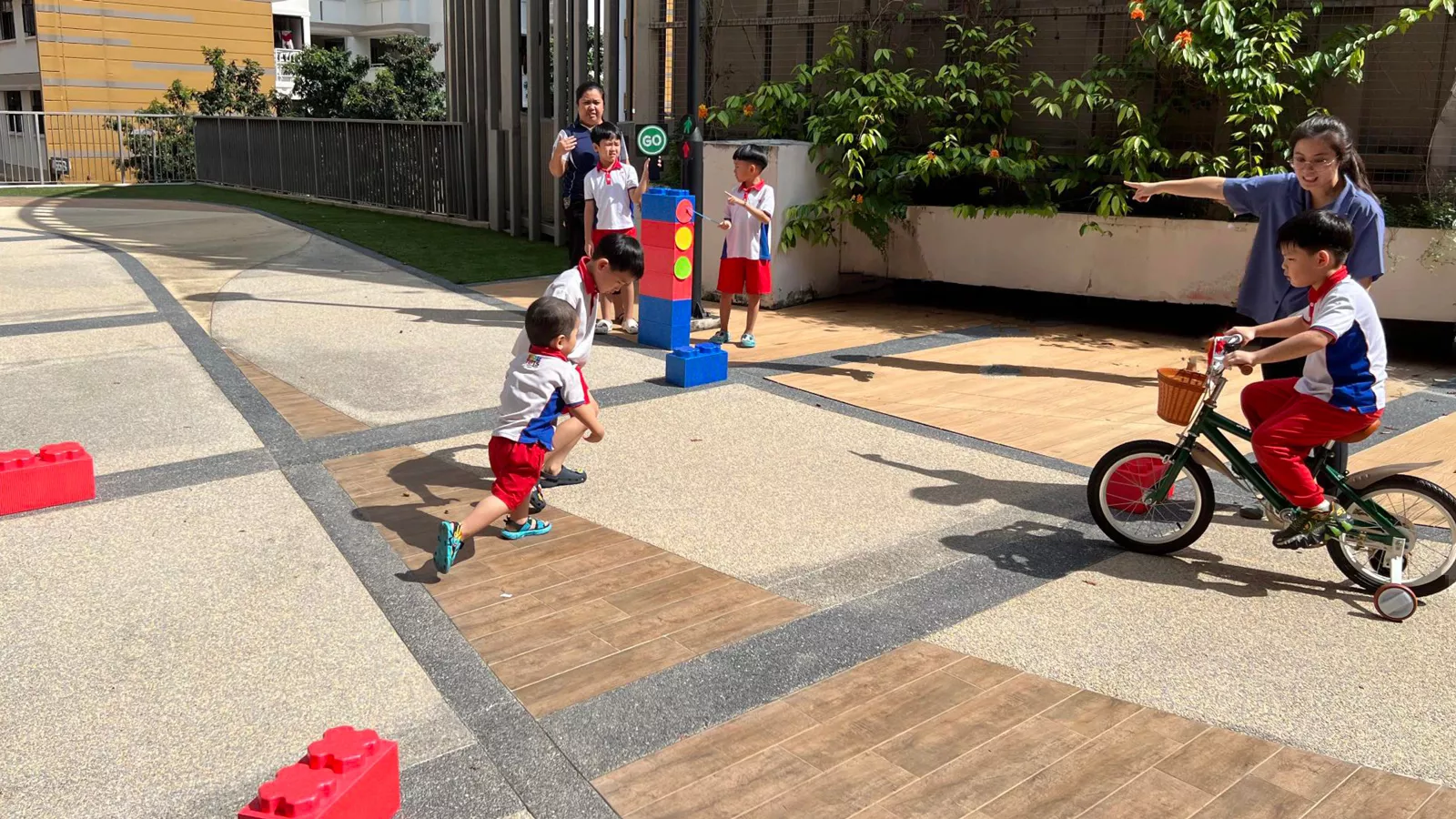 EI educator Ms Lee Wei Ling (right) and her EC colleague co-teach a session about traffic safety rules. To increase engagement, they bring the activity outdoors and have the children play different roles, such as pedestrian or cyclist.
Ms Lee’s contributions extend beyond her centre, through developing resources and conducting training on inclusive practices. For example, she created bilingual training materials on visual supports and behavioural strategies to make inclusive practices accessible to educators and families from different language backgrounds. Initially developed for InSP preschools, these resources have since been rolled out across all PCF Sparkletots centres.
EXPANDING THE InSP
The InSP pilot demonstrated how inclusive preschool practices can benefit all children — both typically developing and with developmental needs — forming one thread of high-quality preschools. An evaluation study was conducted on children’s outcomes and parents’ perspectives in the InSP.
At the Early Childhood Celebrations & Conference in September 2025, Minister Masagos Zulkifli shared encouraging findings from the InSP pilot evaluation study:
- Children with developmental needs in the InSP made significant progress across all domains of development, narrowing the gap with their typically developing peers.
- Typically developing children also benefitted from inclusive teaching practices, demonstrating significant cognitive gains and greater acceptance of peers with different abilities.
- The majority of parents with children enrolled in InSP preschools, regardless of whether their children have developmental needs, would recommend inclusive preschools to other families.
Building upon these promising results, ECDA will expand the programme to more preschools, progressively adding around 600 more InSP places from 2026 onwards.
For Ms Lee, this signals an important step forward in building a culture where diversity is embraced: “Ultimately, it is about nurturing a mindset shift within the sector — where educators, families and children see inclusive practices not as an add-on, but as an integral part of quality EC education.”